Saint Paul Chamber Orchestra
1999-2000 Season Preview Program
Michael Barone,
host of the Saint Paul Chamber Orchestra broadcasts, talks with SPCO Music Director
Hugh Wolff about the new concert season, Wolff's last year with the orchestra.
BARONE: We are here to celebrate a new season
of concerts by the Saint Paul Chamber Orchestra, but there's a touch of wistfulness
in the air since this will be the last season of our young collegial music director,
Hugh Wolff. But we're not saying good-bye yet, but rather "hello" to
the exciting and new concert and broadcast season that is about to begin. So,
Hugh, what have you got up your sleeve for us this year? Do you plan a season
differently knowing it will be your last?
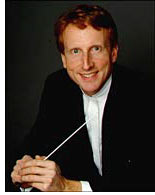 WOLFF:
A little bit - in one's mind is the notion that you'd like to do some
big things that you've never done before it's too late. For example, the way the
season opens with Jean-Philippe Rameau's Suite from Les Boréades and ends with
Beethoven's Ninth, a piece the orchestra really has never attempted. It's a grand
experiment for me as a last concert. WOLFF:
A little bit - in one's mind is the notion that you'd like to do some
big things that you've never done before it's too late. For example, the way the
season opens with Jean-Philippe Rameau's Suite from Les Boréades and ends with
Beethoven's Ninth, a piece the orchestra really has never attempted. It's a grand
experiment for me as a last concert.
BARONE:We'll get to Beethoven a little later - but
what about Rameau caught your fancy?
WOLFF: I had a conversation with Nick McGegan, our
new Baroque Series director, who's done quite a bit of work with Rameau and it's
his edition of Les Boréades that we'll be performing. I think this piece has only
come to light in this last generation - his last opera, and Nick's done a lot
of work to realize it for this orchestra.
BARONE: Rameau seems to be almost the most modern
of Baroque composers in that he uses the orchestra for fantastic effects beyond
what Bach does. Bach's effects are technical, Rameau's are sonorous.
WOLFF: Rameau made the transition from Baroque to
Classical style and in this dance music from Les Boréades there's very little
Baroque counterpoint. There are clarinets, which Bach never used, and the use
of improvised percussion that Nick recommended give this music a real kind of
pizzazz and swing that you don't identify with the more intellectual Baroque music
from the German composers.
Guest Artists
BARONE: Hugh, at the end of September your soloist
will be that remarkable young violinist Hilary Hahn, who played for us last season
so spectacularly. A wise decision to have a return engagement - this woman is
on her way.
WOLFF: I was absolutely stunned and delighted to
collaborate with her. What a wonderful artist and very special person - very young
but very mature, bubbling with ideas. She'll be playing two concertos - Barber's
Violin Concerto, and a concerto written by Edgar Meyer, the double bass player
with whom we've been collaborating with a little bit on the other concert. And
then both pieces will be committed to disc for posterity.
BARONE: Edgar Meyer is a composer who is rather
extravagantly featured in Saint Paul Chamber Orchestra activity this season. He'll
be a familiar name to SPCO attendees this coming season. Hugh, a little bit of
background on him. He was a string bass player for a while who figured there was
more to the instrument than the usual bass repertoire.
WOLFF: He's an extraordinary virtuoso on the double
bass, both classical and crossover in country, bluegrass, and jazz - and has a
prolific recording career in all these genres. We've actually not presented him
publicly here in the Twin Cities, but we've been collaborating quietly with him
in another recording project and finally the local audience gets to hear what
a talent he is. He's an absolutely terrific guy to spend time with - clever, witty,
fun and relaxed, and brings all the atmosphere of a Nashville born country player
and all the extraordinary gifts of a virtuoso.
BARONE: I have to smile when I look at some of
the new repertoire you'll be playing this season, including two works by Michael
Daugherty, one of them called "Tombeau de Liberace." I can just imagine
what that's going to be like.
WOLFF: This is a guy with a major-league sense of
humor. We did one little piece of his called "Dead Elvis" a few years
ago - a hilarious piece where Chris Ullery, our principal bassoonist, got to dress
up in a full Elvis costume. And this is a piece that Christopher O'Riley will
play with us - he's a wonderful showman and loves to get into this kind of theatrical
presentation. Later on in the year we're doing a world premiere called "Sunset
Strip."
BARONE: At the end of October Gil Shaham is coming
to play the Beethoven Violin Concerto, and you're going to perform two recent
works by composers that you may know personally. There's a world premiere of a
new piece by Daniel Godfrey, plus a chamber piece by the young British composer
Nathan Currier.
WOLFF: Yes, I have seized the opportunity in my
final year to showcase some composers whose works I've loved and known. Daniel
Godfrey did a special concert with us at the Walker Art Gallery, and I liked it
very much so I commissioned him to write a new work. Nathan Currier is someone
I've been aware of for quite a few years - a friend of mine out of Juilliard.
This is a work he wrote probably 10 years ago when he was still a student - a
wonderful evocative work for about 20 musicians with accordion.
BARONE: Nick McGegan, music director of the Baroque
Series, will be coming to town in November, bringing with him soprano Dominique
LaBelle for a program of works by Bach and Händel.
WOLFF: The Baroque Series is looking to Bach this
season and the next season. The year 2000 is the 250th anniversary of Bach's death
and so every program on the Baroque series has some Bach or relative of Bach.
We'll continue that through the following season and cover all the Brandenburg
Concertos and all the Suites in the course of two seasons.
BARONE: In February 2000 you're going to be learning
some choral music of Arvo
Pärt and presenting the Bach Magnificat in concert with it. A nice program-an
old and new look at this particular liturgical celebration.
WOLFF: I just think the combination is winning and
the Baroque audience warmed to the notion of a composer like Pärt. The Dale
Warland Singers have specialized in Pärt, and the idea of doing the little
a cappella Magnificat of Pärt and then the grand and glorious Magnificat
of Bach on the same program was irresistible to me.
BARONE: Audiences will certainly get their money's
worth when the Eroica Trio comes to town to play Beethoven's Triple Concerto.
This is a group which has made quite a name for itself-getting into all of the
places where chamber musicians and classical musicians rarely get: the main media,
television, magazine covers . . .
WOLFF: Three lovely young ladies and terrific virtuosos.
There aren't so many trios around these days and we haven't done the Triple Concerto
in a long, long time, so it seemed like a wonderful and logical pairing. They
appeared with the Schubert Club and wowed the Twin Cities.
BARONE: And they've also been on our Saint
Paul Sunday broadcast with Bill McGlaughlin, so it's going to be like old-home
week.
Modern Conducting
BARONE: Talk to me about how it
is that one comes to be music director of an organization and then chooses to
move on from it. In the old days with conductors like George Szell at Cleveland,
it was kind of like a marriage. Marriage was forever and these days marriages
are changed.
WOLFF: It was a very unequal kind
of relationship, and it could survive over 25 years because of the amount of authority
vested in the conductor and the amount of intimidation possible. I'm not so sure
the end result was all that healthy for the musicians - although the quality of
the performances was undeniable. But a lot of musicians who lived through it will
tell you it was no picnic to be playing for someone like Szell day in and day
out. He was extremely demanding and his power was unlimited. His behavior was
sometimes ruthless. It's a different dynamic today and frankly I'm glad it is.
I'm not the kind of person that would have thrived in a dictatorial arrangement.
I probably never would have become a conductor if that was what was expected.
I do think in today's world when music is disseminated worldwide instantaneously,
and conductors travel more readily, that it's possible and beneficial for everyone
that there be music directors and guest conductors, and a tremendous amount of
variety for the subscribers and for the musicians themselves.
BARONE: So you'll probably go on, become very famous
with another orchestra and we'll have a hard time getting you back as a guest
conductor.
WOLFF: No, certainly not!
Beethoven's
Ninth Symphony
BARONE: You're going to end your tenure as music
director officially in May with a concert that concludes with Beethoven's Symphony
No. 9 - the "Choral" Symphony, which I expect that the original founders
of the chamber orchestra would have thought an impossibility.
WOLFF: Well, perhaps this is folly
but it's significant in two ways. First, it completes the cycle of nine Beethoven
Symphonies in my tenure. The orchestra had never done No. 7, I think they'd done
No. 3 once and maybe No. 6 once. They had never done the 9th when I came here,
and if you had asked me 10 years ago if the SPCO should play Beethoven's 9th symphony,
I probably would have said no.
But an experiment early on with the Missa Solemnis and the Schubert 9th led me
to think this was possible and would be fun and illuminating. Particularly the
Missa Solemnis, where I have been frustrated with forces in large performances
by the density of sound - how the textures get clotted and the choir gets obliterated.
So you have an even bigger choir and everybody's shouting at the top of their
lungs. I've done the piece a lot with big orchestras and choirs and there are
huge obstacles to getting clarity and lightness and brilliance and the propulsion
of the last movement. You can certainly get the decibels but when you've got trombones
and cellos and double basses all playing the same thing that the choir basses
are trying to sing, you have a problem. And with the chamber orchestra I don't
think you'll have that problem to that degree.
I think it will be illuminating and fun to hear it that texture and certainly
for me and the chamber orchestra musicians, what a hoot it will be to finally
get to play this music! I'm sure many of them have played, but for us to do it
on our home stage and look at it fresh together, it's going to be a lot of fun.
Hugh's Future Plans
BARONE: When Beethoven's 9th symphony comes to an
end in the last concert in May I will both be rejoicing at the brilliance of music
we will be hearing, but also shedding a few tears in dismay that you will be leaving
us. What's in the plan?
WOLFF: I have a position in Frankfurt
[with the Frankfurt Radio Symphony Orchestra] and a lot of responsibility, and
I also have three sons and I spend too much time trying to do too many things.
In a way for the last three seasons running two orchestras, Frankfurt and St.
Paul, has been too much. My oldest son is ten, and I figure I have 7 more years
and then he's out of the house. So there's a period now in which my focus will
be a little less on the manic career jetting-all-over-the-world. As someone said
to me recently, "If you don't listen to your children while they're young,
they won't listen to you when they're older," and now is my chance to be
slowing down. I'm middle-aged and have to admit it, so it's time to have things
in my life organized in a slightly different way I think.
BARONE: So the future is . . . guest conducting?
WOLFF: The guest conducting I'm doing is now much
more in Europe than in the States. The work I've done in Frankfurt has suddenly
made me well-known in Germany where I was not known at all. It's not something
I particularly sought but it means that invitations are coming in, and we may
settle there for a while and see what happens. But the total number of concerts
and trips on jet airplanes is going to go down for a while and stay down for a
while.
BARONE: But that's then and this is now, the beginning
of this SPCO season for 1999-2000. . . . A lot of wonderful music to look forward
to, many fine experiences and many opportunities to hear you and this great orchestra
together. That should keep us all happy over the coming months don't you think?
WOLFF: Yes and I hope that people don't feel that
this is saying goodbye. I've spent a great portion of my life here. I've done
more concerts with this orchestra than any other orchestra in the world. This
will always be very very close to me and my heart, and hopefully I'll be back
in the Twin Cities on occasion and greet the orchestra and audience in the future
as well.
BARONE: And the studio door here will always be
open for you.
WOLFF: Thank you.
Back to The Saint Paul Chamber Orchestra
home page
|




 Listen
to Hugh Wolff speak on:
Listen
to Hugh Wolff speak on:

